Assignments for Spring Term
Unless otherwise stated, all assignments are from the (1) Fuller casebook (noted as CB) or (2) the Byrne collection of materials (noted as Supp):
- Fuller, Basic Contract Law, 8th ed., 2006, West, ISBN:9780314159014
- Byrne, Restatement 2d Contracts and US UCC Article 2, 4th edition, 2008, Institute of Int’l Banking Law & Practice, ISBN:9781888870466
| Class | Assignment |
|---|---|
| 1/13 | Exam Review and concluding discussion of previously assigned material from Chatpter 9, particularly Foxco Industries, Ltd. v. Fabric World, Inc. (CB p. 406) |
| 1/20 | CB pages 413-429, Chapter 10, The Mechanics of a Bargain (I) Offer and Revocation. Chapters 10-12 of the casebook provide the basis for a study of what contracts law means by the term "agreement" and considers both mechanical and nonmechanical ways by which the courts determine whether the parties have made an agreement. We will not be discussing in class every case and every note in the casebook. Please use the opportunity to ask questions and engage in discussions on our forum as well as in the classroom |
| 1/24 | CB pages 430-448, Chapter 10 |
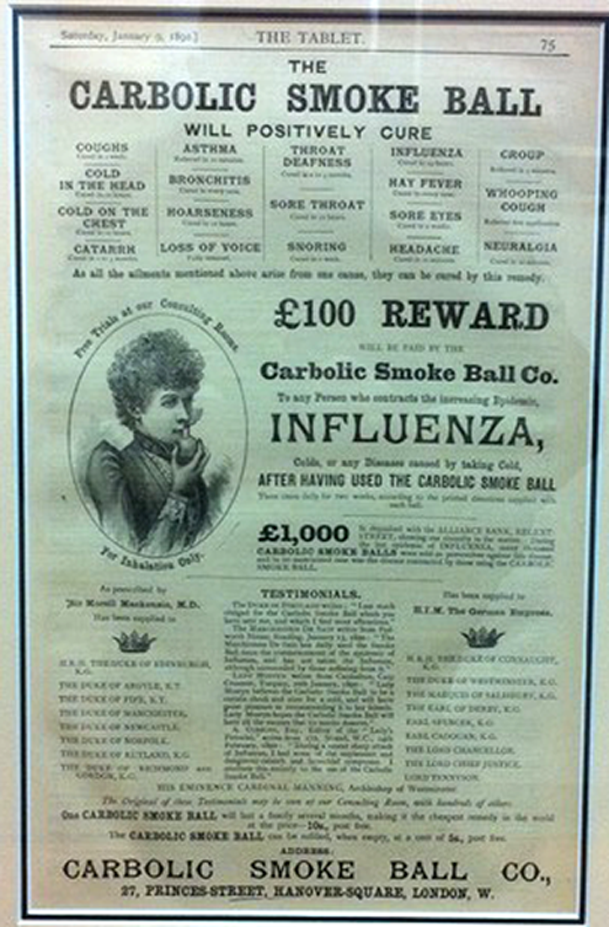
| 1/27 | CB pages 448-469, Chapter 10 and Chapter 11, The Mechanics of a Bargain (II) Transacting at a Distance and Chapter 12, The Mechanics of a Bargain (III) Modes of Acceptance. One of the cases assigned for this class is Carliill v. Carbolic Smoke Ball Co.. You may be interested in taking a look at the newspaper advertisement that gave rise to that case. |
| 1/31 | CB pages 469-488, Chapter 12 |
| 2/3 | CB pages 488-503, Chapter 12 (See Supplement under Resources tab for United States statute on Mailing of Unordered Merchandise) |
| 2/7 | CB pages 504-516, Chapter 13 Chapter 13 contains materials on implied-in-law and implied-in-fact contracts; we will be revisiting material, particularly on implied-in-law contracts that we covered in the fall term under the title "restitution." The last 20 pages of the chapter provides a brief introduction into the world of contracts in the form of employee handbooks, an important emerging part of contract law. We will spend two class hours on this chapter. |
| 2/10 | CB pages 516-535, Chapter 13 |
| 2/14 | CB pages 536-556, Chapter 14 Chapter 14 brings us to the final part of our discussion of what contracts law means by the concept of "agreement" or "mutual assent." In this chapter we see parties who have engaged in negotiation but, to some degree, have fallen short of what they had anticipated to be their agreement in its final form. The issue for the courts is whether they have reached sufficient agreement to constitute an enforceable contract and, if they have not, whether any relief can and should be granted to a party who has detrimentally relied on their belief that an enforceable contract would be achieved by the negotiation. Needless to say, we will once again be revisiting both questions of communication and questions of reliance. |
| 2/17 | CB pages 557-583, Chapter 14 |
| 2/21 | CB pages 584-608, Chapter 15 We now turn our attention to the Parol Evidence Rule and to the Statute of Frauds. Chapter 15 introduces you to the Parol Evidence Rule and then examines why the rule exists and how it is interpreted by the courts. At the heart of the Parol Evidence Rule is the notion that if the parties have taken the time to express their final agreement in writing, it is inappropriate for a court to allow one of the parties to introduce oral or written evidence which in any way alters the written agreement. At the heart of the Statute of Frauds is the concern that if parties do not set out their agreement in writing, there is a possibility that someone will fraudulently claim there was an agreement when, in fact, there was none. What joins these two rules is, of course, that they both concern writing - its importance and when it is required for a contract to be enforceable. What they also share is a conflict within each judge about when a rule designed to improve justice may seem to impede its attainment. |
| 2/24 | CB pages 608-626, Chapter 15 |
| 2/28 | CB pages 626-637, Chapter 15 and Appendix A, Statute of Frauds 1032-1043, 1045-1048, 1053-1057, 1060-1076 and UCC 2-202, 2-204, 2-207 (both present [Byrne Sup p.565] and proposed [Byrne Sup p. 567]) including Offical Comments |
| 3/3 and 3/7 | CB pages 664-691, Chapter 16 Chapters 16 and 17 focus on the special problems created by the use of form contracts. We have from time to time mentioned form contracts, but these two chapters develop in detail both problems in determining whether an enforceable agreement exists when a form created by one party is evidence of agreement and whether different rules of interpretation need to be applied in the interpretation of form contracts. |
| 3/10 | CB pages 692-712, Chapter 17 |
| SPRING BREAK | |
| 3/21 | CB pages 714-732, Chapter 18 Chapter 18 deals with the Contracts doctrine of Mistake. You should reflect on its relationship to the material with which we began the semester, the doctrine of Mutual Assent. Are the underlying policies the same or different? What does each tell us about the other and about the goals of Contracts law? Section 1 of Chapter 18 introduces the law of mistake by examining a judicial decision in a case in which one party has made a mistake and wishes to be excused from performance. Section 2 presents a case in which there has been a mistake in the transcription of an agreement, that is, that the writing does not correctly reflect the agreement of the parties. |
| 3/24 | CB pages 732-749, 757-761. Section 3 of Chapter 18, raises the question of the proper disposition of cases in which it is argued that the parties were mutually mistaken. Section 4 considers the impact of non-disclosure. Fraud is a defense, but how should the courts deal with nondisclosure, during negotiations, of relevant facts? |
| 3/28 | CB pages 765-786. Chapter 19 considers the scope of a different kind of defense, not mistake (something which occurs contemporaneously with the contract formation) but rather something unanticipated that occurs after the contract has been made. During two class sessions we will discuss both the common law and the UCC resolutions of such situations as well as other possible rules. |
| 3/31 | CB pages 786-809. Tonight we complete our discussion of the law of the effect of unexpected circumstances. |
| 4/4 | CB pages 886-914. Chapter 22 presents our first formal look at what is meant by performance in good faith. As you might expect, it is easier to embrace the notion that parties should perform in good faith than it is to create a clear standard by which conduct can be appropriately classified as good fath or bad faith performance. Consider carefully the standards being defined in the cases we will discuss. |
| 4/7 | CB pages 915-933. Chapter 23 brings us to the doctrine of substantial performance. It deals with the question of how courts should deal with performance that is almost, but not quite, complete in a variety of circumstances. |
| 4/11 | CB pages 934-941, 945-948, 954-959. Chapter 24 brings us back to express conditions, a topic we looked at briefly in our Fall semester discussion of consideration. |
| 4/14 | CB pages 975-996. Chapter 25, titled by the casebook authors as "Breach and Response" is sometimes referred to as the law of implied conditions. It deals with the problem of order of performance and self-help. |
| 4/18 | CB pages 997-1012, 1023-1029. Chapter 26 focuses on the doctrine of anticipatory repudiation, sometimes called anticipatory breach. What consequences follow when one party, in advance of its obligation to perform, appears to be saying, or acting, in a way that suggests that they do not intend to perform when the time for performance arrives? |
| 4/21 | Most of the contracts we have studied this year involve the creation and enforcment of agreements between two parties. There are, however, circumstances in which the court recognizes the rights of a third party to enforce the contract. We are going to look briefly at two of these - Third Party Beneficiary Contracts and Assignment of Contracts. Tonight we will talk about the first of these. Please read CB pages 812-826 and pages 835-844. |
| 4/25 | Tonight we will address Assignment of Contracts. Time does not permit an in depth consideration of this body of law, but it is important that we look at important aspects of the law dealing with this topic. Please read CB pages 860-874. |
| 4/27 | LAST CLASS - REVIEW - Please submit your questions to me by Tuesday night and I will include answers to as many as possible during our review session at 8:00-9:15 p.m. tonight, Wednesday, April 27. The academic calendar requires that classes tonight follow the Monday schedule. |